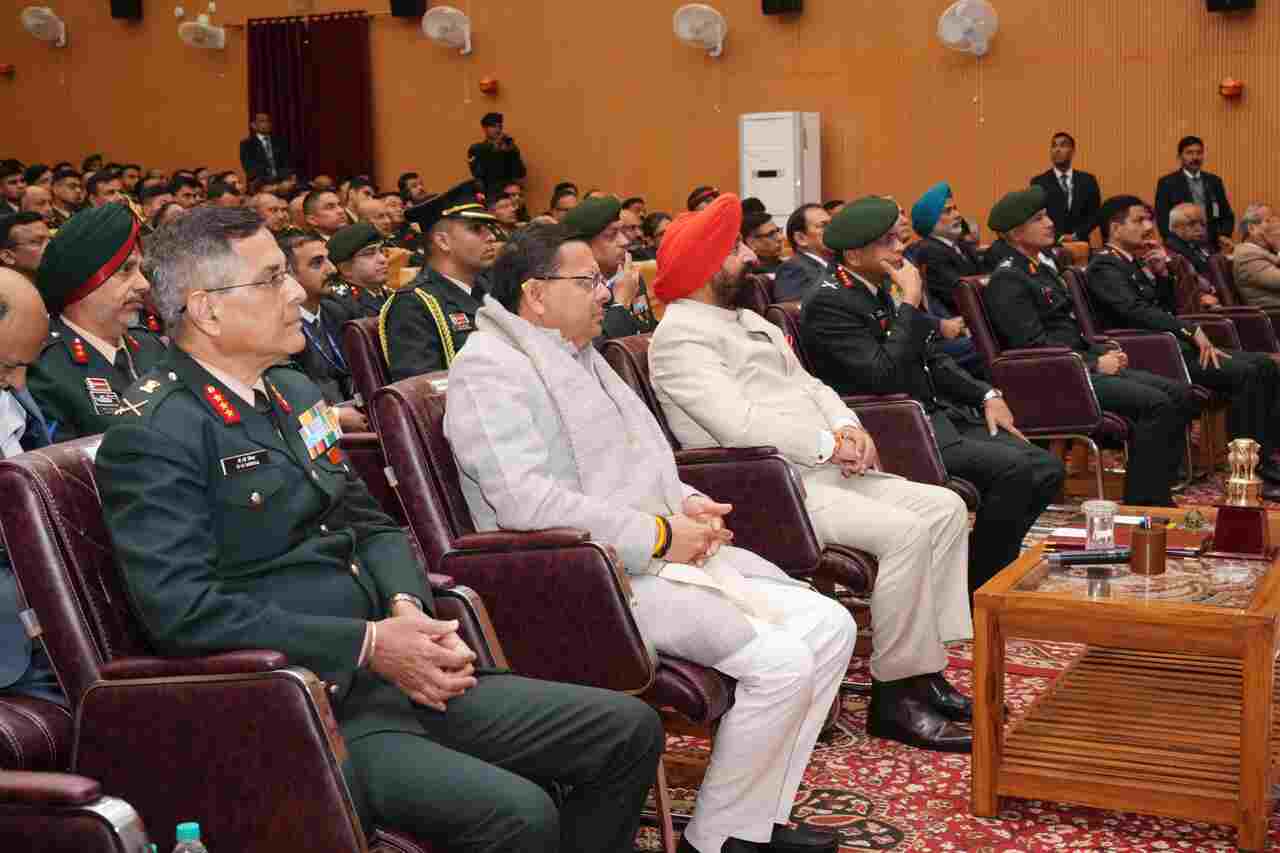
Dehradun: Governor Lieutenant General Gurmit Singh (Retd.) participated in a seminar today at Clement Town, Dehradun, on the topic “Fortifying the Himalayas: A Proactive Military-Civil-Society Fusion Strategy in the Middle Sector”. In his address, the Governor said that the Himalayas are not merely a geographical boundary, but a vibrant strategic system where geomorphology, infrastructure, population, governance, and military capabilities are in constant interaction. He said that although the middle sector has traditionally been considered relatively peaceful, the current circumstances demand continuous vigilance and preparedness. He emphasized the need for effective coordination between the military, civil administration, and society to strengthen the security system in the Himalayan region, especially in the middle sector of the India-China border.
The Governor said that contemporary security challenges are no longer limited to direct military activities, but are also shaped by factors such as hybrid warfare, grey-zone activities, dual-use infrastructure, and continuous pressure in border areas. In such a scenario, the long-term security of the Himalayan regions can be ensured not only through military preparedness but also through effective coordination with civil administration, local communities, and technology.
He described border villages as a crucial component of national security, stating that local communities are not just beneficiaries but also partners and force multipliers in border security. He said that programs like ‘Vibrant Villages’ strengthen social and economic development, as well as population stability, logistical robustness, and a sustained national presence in border areas.
The Governor highlighted the role of infrastructure in the high Himalayan regions, stating that roads, tunnels, bridges, air connectivity, and telecommunication facilities are essential components of operational readiness. Referring to the Char Dham project, he said that it not only strengthens pilgrimage and disaster management but also enhances strategic mobility and security preparedness.
He underlined the importance of modern technology, stating that drones, advanced surveillance systems, and artificial intelligence-based platforms aid in situational awareness and rapid response, but technology cannot be a substitute for leadership, wisdom, and institutional strength.
The Governor also said that environmental balance in the Himalayan regions is directly related to operational capability. Environmental degradation not only affects lives and livelihoods but also has an adverse impact on logistics, communication, and disaster management. He emphasized the need for a balanced approach between tourism, environmental protection, and security requirements.
Concluding his address, the Governor said that the true strength of the Himalayan borders lies in quiet preparedness, institutional coordination, and social trust. When the armed forces, civil administration, and society work together, the Himalayan borders become more robust, stable, and secure. Focus is being placed on community and infrastructural development in border areas – Chief Minister
On this occasion, Chief Minister Pushkar Singh Dhami, in his address, said that the seminar on the security of the Himalayan region, disaster management, strengthening of infrastructure, and civil-military relations is of utmost importance. He said that the suggestions emerging from the seminar will help in strengthening our strategic policy and will also play a significant role in the development of the Himalayan region.
The Chief Minister said that given the challenging geographical conditions and limited population of the Himalayan region, better coordination between the army, citizens, civil administration, and technical experts is essential. The citizens living near the borders in the Himalayan regions are the greatest strength of the country, who truly act as the eyes and ears of the nation and make a significant contribution to national security. He said that protecting the nation is the responsibility of every citizen along with the army.
The Chief Minister said that under the able leadership of Prime Minister Narendra Modi, work is being done towards the development and empowerment of border villages under the Vibrant Villages Program. He said that Prime Minister Narendra Modi is the first Prime Minister of the country to visit a remote and strategically important area like Mana, a border village. It was he who declared Mana not as the last village of the country, but as the first village of the country. The Chief Minister said that the state government is working with determination for the development of border areas and the welfare of its citizens.
GOC-in-C, Central Command, Lieutenant General Anindya Sengupta, expressed his views on the challenges of the border in the central sector, the empowerment of civil society, and technological upgradation, as well as infrastructural development.
Ambassador Ashok K. Kantha (Retd.), Brigadier Anshuman Narang (Retd.), Lieutenant General Syed Ata Hasnain (Retd.), and others were present on the occasion.