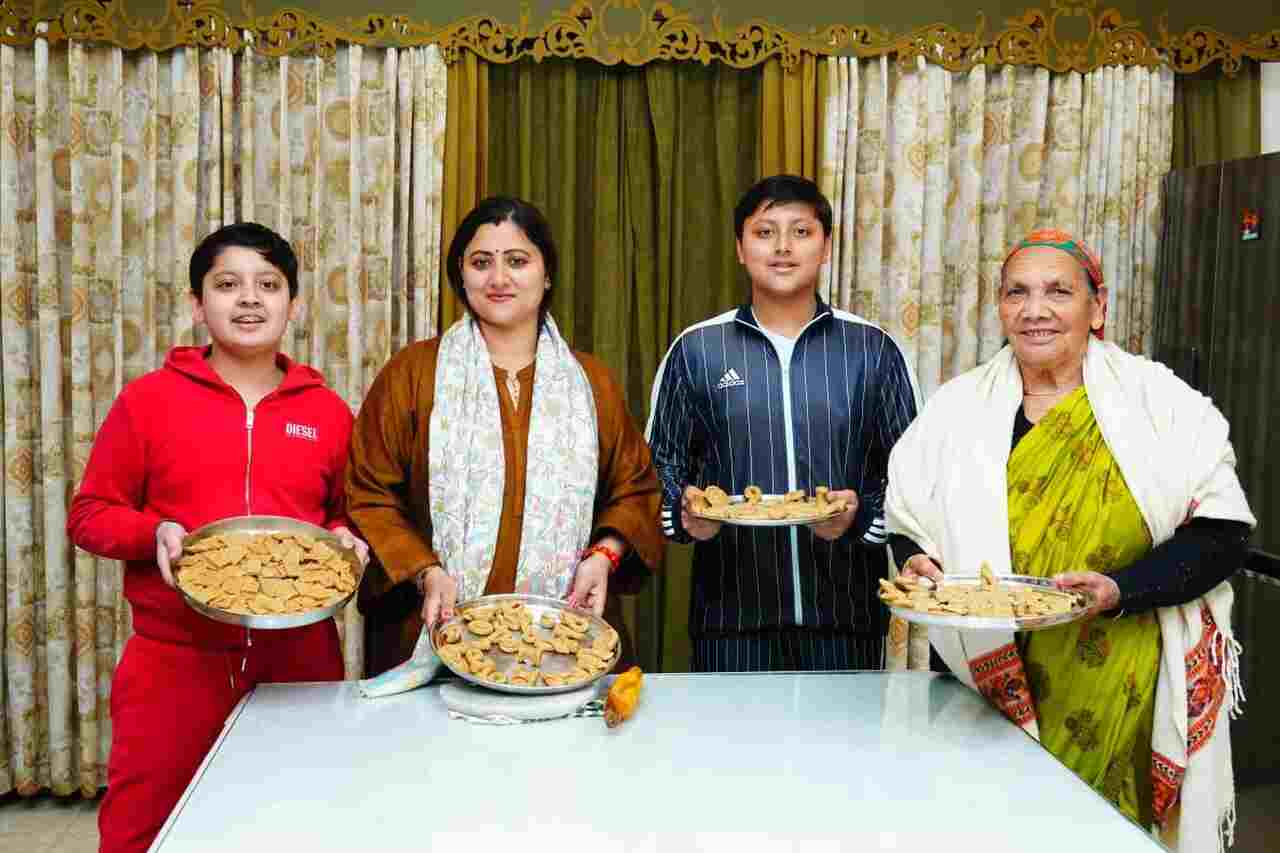
Dehradun/Almora: Today is Makar Sankranti, also known as the Ghughutiya festival. This festival holds special significance in Uttarakhand. Children in Kumaon are very excited about the Ghughutiya festival. Ghughuts (a type of sweet) are made in the evening on Makar Sankranti. The next day, children invite crows to eat the Ghughuts. Uttarakhand Chief Minister Pushkar Singh Dhami has extended his greetings to the people of the state on Makar Sankranti, Uttarayani, and the Ghughutiya festival. The Uttarayani festival is also being celebrated at the CM’s residence. The Chief Minister’s wife, Geeta Dhami, shared a picture with her mother-in-law and children along with Ghughuts on social media.
CM Dhami extends Uttarayani greetings: CM Dhami wrote on his social media account:
“Hearty congratulations and best wishes to all the people of the state on the auspicious festivals of Makar Sankranti, Uttarayani, and Ghughutiya, which are associated with the rich folk traditions of Uttarakhand. This auspicious festival of the sun’s transition from Dakshinayana to Uttarayana is a symbol of our folk faith, connection with nature, and new consciousness in life. May this auspicious festival bring happiness, prosperity, and new energy into all your lives, this is my prayer.”
CM Dhami’s wife shares children’s photos: In Kumaon, the Ghughutiya festival is celebrated with great joy and enthusiasm along with Makar Sankranti, marking the sun’s transition from Dakshinayana to Uttarayana. It is also considered a symbol of seasonal change and positive energy. The tradition of celebrating this folk festival has been passed down from generation to generation. The Makar Sankranti festival is also being celebrated at the Uttarakhand CM’s residence. The CM’s wife, Geeta Dhami, has posted a message on social media with some wonderful pictures. “Black crow, black, eat the Ghuguti garland”
While preparing for the auspicious folk festival of Uttarakhand, Uttarayani-Ghuguti Tyar, with my mother, we made traditional dishes like Ghuguti and Khajure from sweet dough. These are not just dishes, but a living embodiment of our folk traditions, faith, and values. In such moments, the home kitchen becomes a school of culture, where history and identity are cooked along with the flavors.
On this occasion, both my sons, Diwakar and Prabhakar, were also involved in this special tradition, as they are every year, and were made aware of its importance. When children see and understand the preparation of the festival, the sentiment behind it, and the true meaning of folk beliefs and traditions, the festival is not limited to books or stories but becomes a natural part of their lives. This vibrant experience of traditions creates a strong bridge between generations and continuously promotes our folk culture of Uttarakhand.
The Uttarayani-Ghuguti Tyar reminds us that folk culture remains alive only when it is lived in daily life. More than just following traditions, understanding them and passing them on to the next generation is the true protection of our cultural heritage.
Hearty congratulations and best wishes to all on Ghuguti Tyar/Utarayani. – Geeta Dhami, wife of CM Dhami –
Ghugutiya festival being celebrated with great pomp in Uttarakhand: The Ghugutiya festival is mainly celebrated with great faith and enthusiasm in the cities and villages of Almora, Bageshwar, Pithoragarh, Champawat, and Nainital districts of the Kumaon region. On the day of Makar Sankranti, people take a bath and perform puja in the morning. They also make special dishes to celebrate the Ghugutiya festival. The traditional sweet dish called Khajur, which is called “Ghugut” on this occasion, is made in every household in Kumaon.
These dishes are made on Uttarayani: This traditional sweet dish is made by mixing wheat flour, jaggery, and ghee. This dish is given various shapes. These include many traditional shapes such as bows, drums, fish, flowers, hourglass drums, swords, and shields. They are dried in the sun and then fried in ghee or oil in the evening. The ghuguts are then strung together to make beautiful garlands for the children of the house, with oranges also strung along with the ghuguts. The children are very excited about these garlands. The next morning, the children wear these garlands around their necks and, with the first rays of the sun, perform the tradition of calling the crows.
The children invite the crows in this way: On the morning of the second day of Makar Sankranti, after bathing, the children wear the ghuguti garlands and gather in groups on the roofs and courtyards of their houses, calling out to the crows and inviting them to eat the ghuguti. During this time, the children call out, saying: “Black crow, black crow, eat the ghuguti garland, take the crow’s puri and give me a golden knife, take the crow’s big puri and give me a golden pot, take the crow’s orange and give me a beautiful sarangi,” and so on, to call the crows.
There is also this belief: It is believed that when the children call, the crows come and take the ghuguts, which is considered auspicious for the well-being and peace of the entire family. It is believed that offering food to the crows pleases the ancestors and forefathers of the family, and their blessings are bestowed upon the entire family. It is also believed that if there is any ancestral curse, it is removed, bringing happiness and prosperity to the family.